
Marrakesh, Marronage, and What Nine Black Women Taught Me
"We were not interested in creating tourists yet interested in creating researchers and global citizens."
Before language, there is sensation. Before argument, there is the body's knowing… its accumulated record of every place it has stood, every weight it has carried, every threshold it has crossed and not crossed. I have spent my life as a choreographer, a scholar, a teacher insisting on this truth: that the body is not a vehicle for ideas but a site of rigorous, irreducible intelligence. That movement is not illustration. It is inquiry and archive. It is how we come to know what we most deeply know.
Morocco confirmed that truth. And then it cracked it open.
This summer I led nine Spelman College students into four weeks of Diasporic Research in Performance in Marrakesh, a living curriculum built on the belief that Black women deserve to encounter Africa not as inherited idea, not as romantic abstraction, but as a breathing, resistant, generative presence. A place that presses back. A place that teaches by refusing to be contained by what you brought with you.
I had been building toward this for years. Returning to Morocco again and again listening, learning, earning trust before I ever brought students into those spaces. The partnerships that sustained this program, with Mwasi, with local artists, educators, language instructors, community members, did not emerge from institutional convenience. They emerged from relationship. From sustained, reciprocal, unhurried relationship. That is itself a methodology. That is itself a form of research.
What I did not fully prepare for was Morocco doing the same thing to me.
My pedagogy is rooted in marronage; that fugitive, defiant tradition of refusal and reimagining that runs through Black diasporic life like an underground river, like a vein of something precious and pressurized. I carry it into every studio, every classroom, every conversation: name the condition that limits you, then imagine past it. Strategize toward the possibility that does not yet exist. Move boldly. Move now. In the American context, this is legible as self-determination, as leadership, as the grammar of becoming.
In Morocco, I discovered the grammar did not translate cleanly.
Conversation after conversation with artists, dreamers, entrepreneurs shaped by Amazigh, Arab, Islamic, and post-colonial inheritance, returned me to a different architecture of risk. To pursue an uncertain path, in this cultural context, was not automatically legible as courage. It could be read as severing from family, from obligation, from the sacred relational web that gives individual life its meaning and its anchor. What I had offered as an invitation to possibility arrived, for some, as a challenge to a deeply held ethic of care.
I had to sit inside that. I had to resist every instinct to explain it away, to smooth it into something comfortable. I had been moving through the world with my philosophy held like a lantern, assuming its light was universal. Morocco showed me the lantern was also casting shadows I hadn't bothered to see.
This is what genuine cross-cultural inquiry demands: not the relief of recognition, but the rigor of true encounter. Not tourism. Not extraction. Encounter…the kind that leaves marks on both sides.
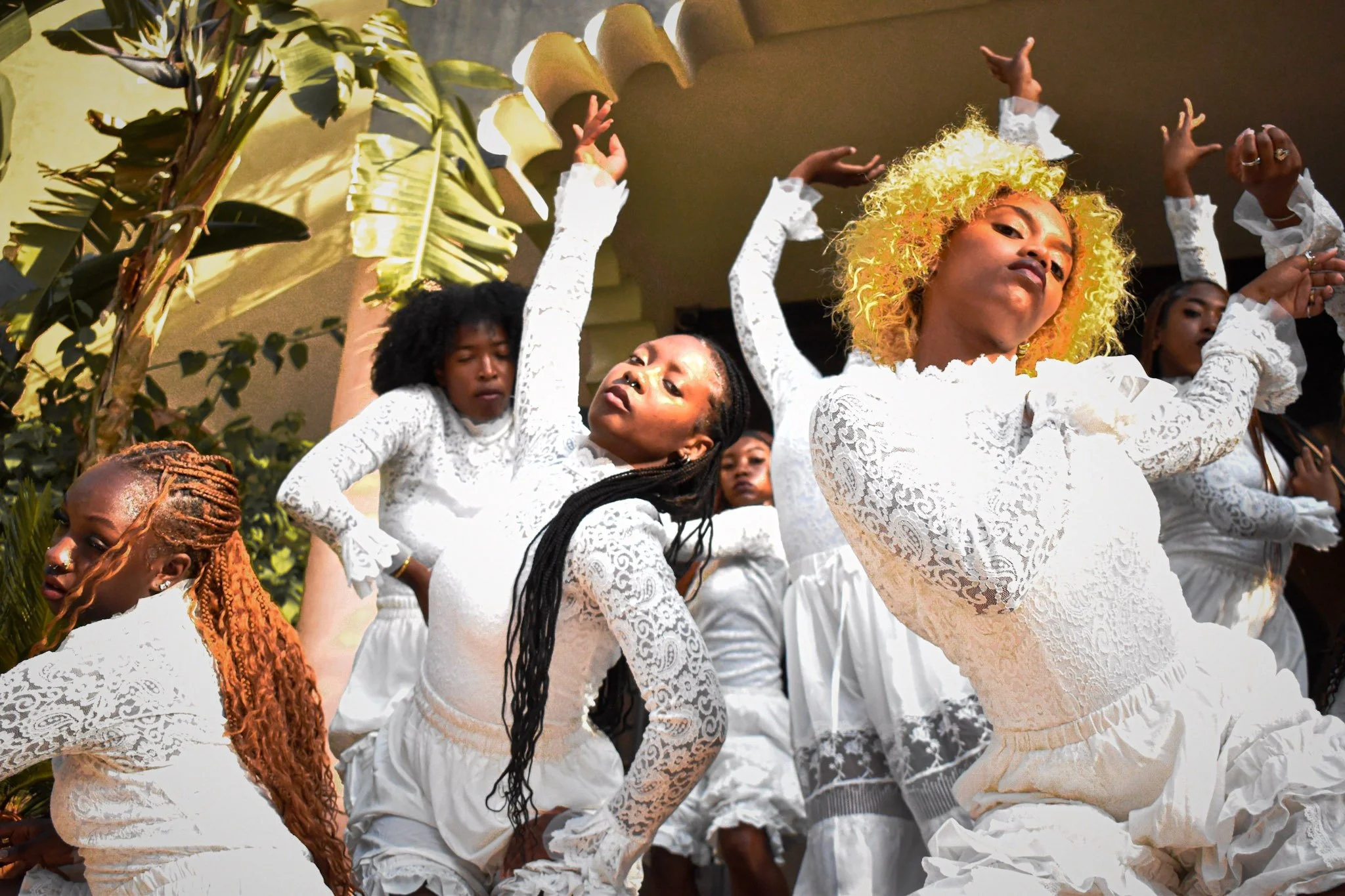
Spelman College Dance Majors in Marrakesh. Photo by Umi Iman
Meanwhile, nine young women were doing their own sacred work.
Each morning opened in language specifically, in Darija, the Moroccan Arabic that lives in the mouth differently than anything these students had spoken before. This was not incidental. We began there because language is embodied before it is understood, because the way a tongue finds a new sound, the way the lips and jaw negotiate an unfamiliar shape, is itself a form of movement invention. Learning to speak Darija was learning to move in a new way. It was the body's first act of cultural research. From there the day spiraled outward: through movement practice, medina walks, community workshops with children from a local orphanage, AI image-generation critique, and collaborative performance-making not as separate activities but as a single, continuous inquiry into what the body knows that no data set can hold, what encounter offers that representation cannot.
One student, Arion Malone, showed me what it looks like when a young artist decides to fully inhabit a question rather than manage it from a safe distance. Arion moved, across those four weeks, into the territory where most artists flinch and retreat - faith, paradox, the irreducible, knotted complexity of Black womanhood. She did not seek resolution. She sought precision. The specific gesture. The exact quality of weight. The performance choice that could hold contradiction without collapsing it, that could carry multitude without pretending to simplicity.
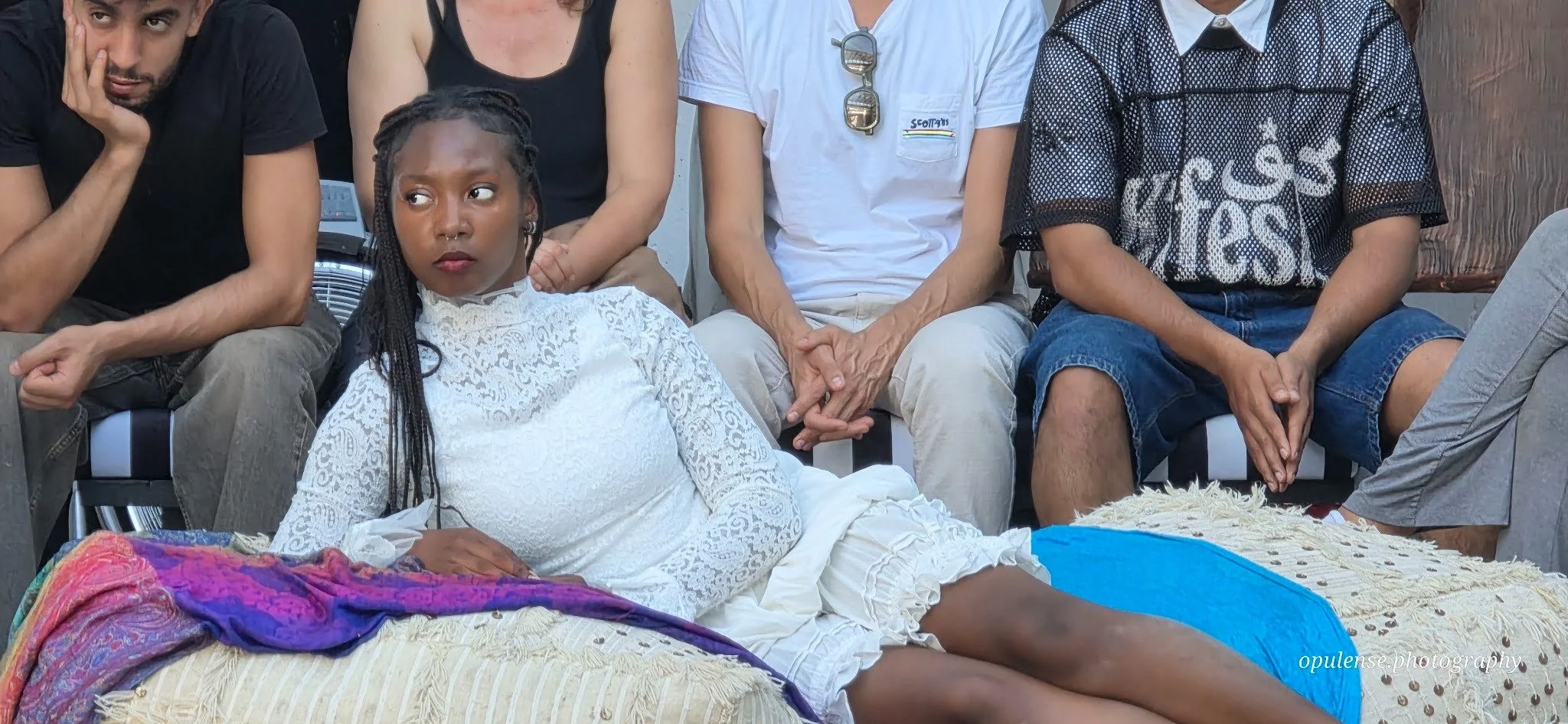
Spelman College Dance Major, Arion Malone. Photo courtesy of the Mandarin Oriental, Marrakech
By the time we staged our culminating work, Thighs of Thunder, Arion was not performing ideas. She was thinking in movement. The work itself takes its name as a deliberate provocation; a play on the ancient Gnostic text Thunder, Perfect Mind, that radical, paradox-saturated voice that declares itself simultaneously exalted and abject, knowing and unknowing, feared and desired. To carry that text into the body of a Black woman, into the thunder of her thighs, into the specific gravity of her presence on a stage; that is the kind of artistic argument that cannot be made any other way. Arion understood that. Her artistic voice had arrived: not borrowed, not performed for approval, but earned through sustained, unflinching inquiry into her own becoming.
That is what I mean when I say dance is research. Not as metaphor. As methodology. As epistemology. As a laboratory for liberation.
We also asked students to reckon with artificial intelligence; not as passive consumers of a technological moment, but as critical thinkers with the authority to hold it accountable. Inside a course module called Teaching the Machine to Behave, they used AI image-generation tools to investigate how algorithms represent culture, identity, and human experience. What they found was instructive and clarifying: the machine had learned from data, not from living. It could produce an image of Morocco. It could not produce the weight of the medina at dusk. The sound of prayer reshaping the air around your body. The particular, irreplaceable knowing that passes between two people moving together before either has found a shared word. The distance between the generated image and the lived encounter became its own site of inquiry; proof, held in the hands, that the body still knows things the machine does not.
I came home clarified. Humbled in the precise way that is generative rather than diminishing. My commitment to marronage, to the fugitive imagination, to moving boldly toward possibilities that do not yet exist, that holds. It deepens. But I carry it now with what I can only name as a harder-won wisdom: that imagination and obligation need not be enemies, that risk is always situated, always relational, always answerable to something larger than the self. That creativity and freedom are culturally located practices; not universal currencies, but gifts that must be offered with care, with context, with the genuine willingness to be taught.
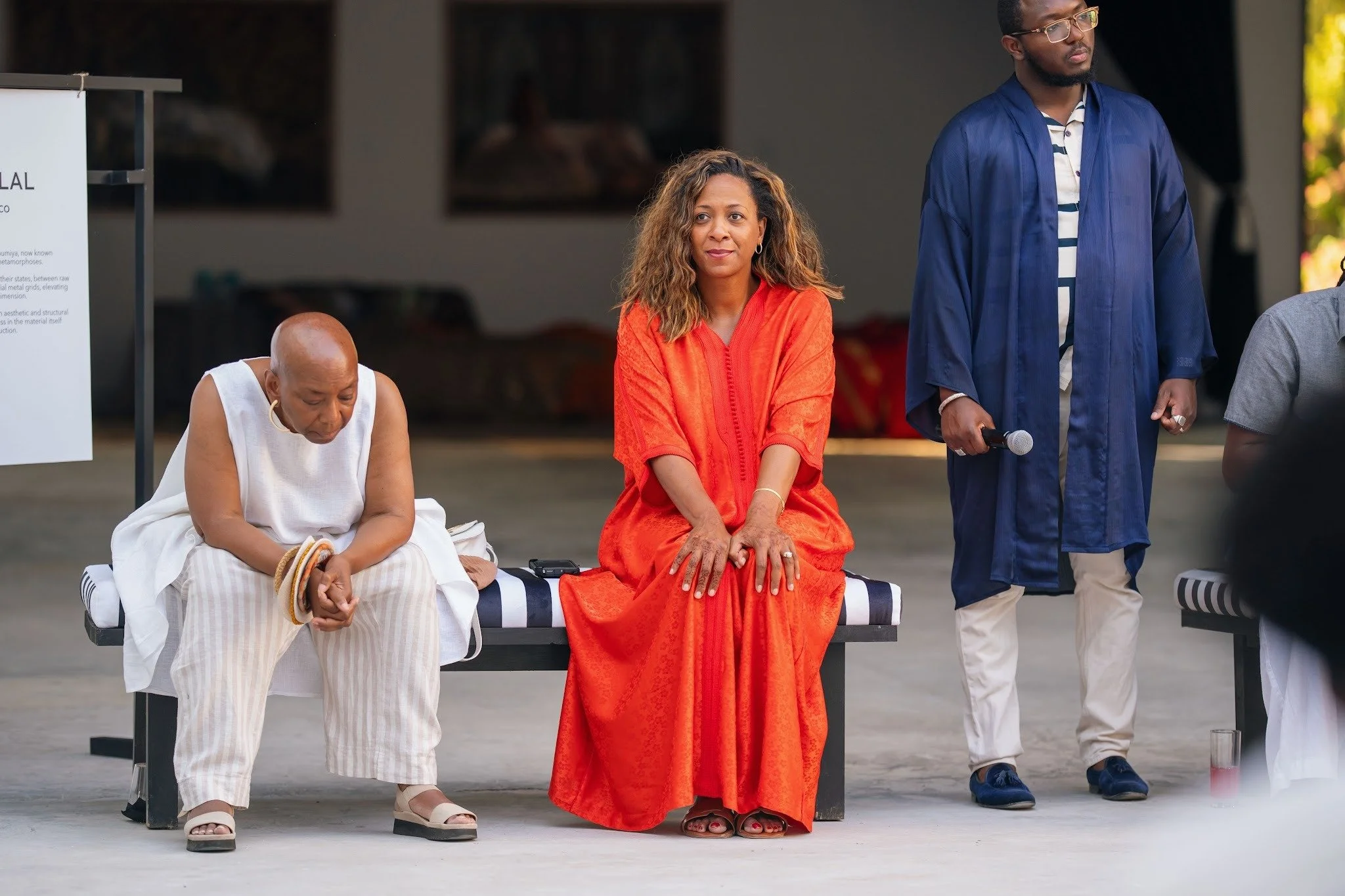
T. Lang in orange. Photo courtesy of the Mandarin Oriental, Marrakech
Morocco taught me that. Arion taught me that. Nine young Black women who arrived as dancers and left as scholars, researchers, cultural thinkers, world-makers; they taught me that. To build the conditions in which genuine questions can be asked is the work. To remain present, and changed, when the answers that come back are not the ones you carried in that is the practice. That is, finally, what it means to be a teacher-scholar. Not the one who arrives with the light already lit. The one willing to walk into the dark alongside the students and see what becomes luminous there.